Showing posts with label fantasy. Show all posts

Monday, October 31, 2011

Review: The Legend of Beka Cooper by Tamora Pierce

The Legend of Beka Cooper consists of three books: Terrier, Bloodhound, and Mastiff
by Tamora Pierce
October 24, 2006;  April 14, 2009; October 25, 2011
Purchased all Three
Goodreads Page
Overall Grade: A


Synopsis from Terrier:  Tamora Pierce begins a new Tortall trilogy introducing Beka Cooper, an amazing young woman who lived 200 years before Pierce's popular Alanna character. For the first time, Pierce employs first-person narration in a novel, bringing readers even closer to a character that they will love for her unusual talents and tough personality.

Beka Cooper is a rookie with the law-enforcing Provost's Guard, and she's been assigned to the Lower City. It's a tough beat that's about to get tougher, as Beka's limited ability to communicate with the dead clues her in to an underworld conspiracy. Someone close to Beka is using dark magic to profit from the Lower City's criminal enterprises—and the result is a crime wave the likes of which the Provost's Guard has never seen before.


With the publication of Mastiff over the weekend, the Beka Cooper trilogy is finally complete.  I stayed up all night Saturday to finish it, and while I’d feel silly writing a review of the third book of the trilogy, I figured I’d try to write a quick review of the trilogy as a whole for those who haven’t picked it up.

The Beka trilogy (or, more properly The Legend of Beka Cooper) is different from the majority of Tamora Pierce’s Tortall books in that you don’t really need to know anything about the multitude of other series because it’s set about 200 years prior to the general action.  It’s also really, really good.

Beka Cooper begins as a trainee Dog (a Puppy) - one of the Guards who act as police in the capital city of Corus.  In the Lower City, the Dogs are vastly outnumbered by thieves, slavers and murderers, and 2 Puppies in ten die before their year of training is up.  She’s incredibly shy but determined to protect her people and her city as well as she possibly can. 

Each book is told through Beka’s journalling of the events, and while sometimes the journals feel more like simple first person narration, I love that we get not only the action and conversation that occurred but also Beka’s thoughts and reflections on the situation.  She has a very definite viewpoint on the proper way of things (which, happily, is not the same as a modern person’s proper way of things), and her devotion to duty and sense of humour shine through the writing.  I also really enjoy that Beka often brings up the memory tricks (memory palace!) she was taught that allow her to remember events as accurately as possible.

Through the three books, we get to watch Beka grow from a shy adolescent Puppy to a fully grown woman confident in her own power and capabilities.  It’s a really well done character arc, and while Beka at the end of Mastiff is very, very different from the girl at the beginning of Terrier, the path she took to get there is completely clear.

Along with Beka, we get a wide range of secondary characters from the other Dogs at the station  to some colorful ladies and gentlemen who range themselves on the other side of the law to Beka’s siblings and friends in the Lower City.  Her training officers, Goodwin and Tunstall, are some of my favourite characters.  They’re wonderfully written hard-bitten and incredibly competent police officers who teach Beka the ropes of their difficult and dangerous job.  I also adore the flirtatious and snarky Rosto the Piper who manages to make friends with Beka even though he definitely has little use for minor things like laws against thievery or murder.

As opposed to a more typical fantasy world storyline, these books all are police procedurals with definite homages to the classics of the genre.  Gods and magic come into play as they always do in Tortall, but the relationship of Beka and her compatriots to most mages is one of slightly annoyed cooperation.  Think of the reactions of Law & Order detectives to the psychologists or sometimes lawyers - it’s kind of awesome especially from the typical fantasy perspective of mages as the ultimate source of knowledge and competence.

There’s a lot of dialect and slang in these three books, but most of the terms are either easily understood from context or there’s a nice glossary and cast of characters at the back of each book.  I’m not the best judge because I don’t have much of an issue with crazy fantasy dialects, but I don’t believe they’d cause much of a hurdle for a new reader.

Most of this review is towards non-Tortall readers, but if you have read some Tortall books, you'll get even more out of these books including bookend cameos by that other slightly less law-abiding Cooper, George, and a starring role by one particular black Cat with purple eyes. Also a really neat look at how society was before lady knights faded away and bits about why that changed (beyond, you know, making Alanna special).

These is a seriously fantastic trilogy.  The Aly books (Trickster’s Choice and Trickster’s Queen) remain my favourite Tortall series, but I can’t help but look at Beka Cooper’s trilogy as the best written.  The first and third books are stellar, and while the second droops a little under the weight of second book syndrome, it’s still a worthwhile and good read.  If you haven’t read any Tamora Pierce yet, consider starting here.  She’s one of the godmothers of the strong YA heroine, and she’s worth reading by every YA reader who loves powerful and capable characters.

Tuesday, October 11, 2011

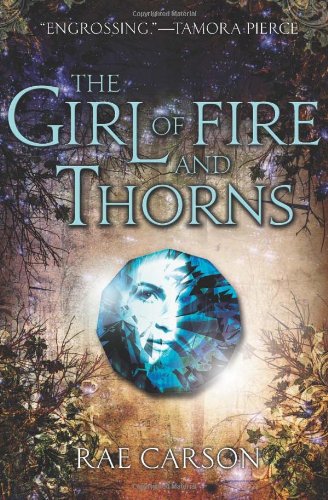
Review: The Girl of Fire and Thorns by Rae Carson

The Girl of Fire and Thorns
by Rae Carson
September 20, 2011
Bought in Hardcover
Amazon Page
Goodreads Page
Grade: B+

Once a century, one person is chosen for greatness.

Elisa is the chosen one.

But she is also the younger of two princesses, the one who has never done anything remarkable. She can’t see how she ever will.

Now, on her sixteenth birthday, she has become the secret wife of a handsome and worldly king—a king whose country is in turmoil. A king who needs the chosen one, not a failure of a princess.

And he’s not the only one who needs her. Savage enemies seething with dark magic are hunting her. A daring, determined revolutionary thinks she could be his people’s savior. And he looks at her in a way that no man has ever looked at her before. Soon it is not just her life, but her very heart that is at stake.

Elisa could be everything to those who need her most. If the prophecy is fulfilled. If she finds the power deep within herself. If she doesn’t die young.

Most of the chosen do.


This is one of those books where there are problems and frustrations you note as you read it, but then when you close the book after the last page, sigh happily, and say ‘that was a good story.’  Carson wrote a very satisfying type of traditional fantasy that I, an inveterate fantasy reader, couldn’t help but gobble up in one sitting.  And yet there are many of the flaws of a traditional high fantasy book as well.

Elisa is an interesting heroine who makes me oh-so-conflicted.  She hates herself so very much at the beginning of the book that it’s difficult to get much of a read on her personality.  Always shadowed by talented older sister, Elisa’s never had much asked of her, and even if she’s the bearer of the Godstone, she’s pretty certain that standing up for herself is something she’ll never be able to do.  Yet when she’s married off to a neighboring monarch, she manages incredible bravery under very difficult circumstances. That contradiction between her bravery and sense of duty and self-loathing provides much of the internal conflict throughout the book.

My problem here is one that has been mentioned many times, and that’s the issue of Elisa’s weight.  I absolutely love seeing a heroine who’s both a POC and not perfectly fit, but so much of her self-hatred is based in her weight, and much of it - both self-hatred and weight - disappears once she experiences near literal starvation in the desert.  I always enjoy seeing a character come into her own, but I would have loved it so much more if Elisa came to love herself and respect herself as she was at the beginning of the story.  She’s brave before she loses weight, but she becomes a respected leader afterwards.  I think the entire character journey could have been so much more powerful done differently.

But for the parts of Elisa that I loved, I loved her booksmarts and ability to think completely tactically when needed.  There are several times where very difficult decisions had to be made, and I admire the character for being able to make those unflinchingly.  I loved watching her attempt to adapt to different cultures.  I really liked how she apologises when she’s in the wrong, and how she’s determined to fulfill her duty as the bearer of the Godstone.  The character rarely felt sixteen to me.  Often she seemed much older, but I can find that believable as a simple function of having been raised a princess.

Carson’s world-building is consistently well done from the Spanish influence of Elisa’s home kingdom of Orovalle to the hill people to the mix of cultures in Brisadulce.  And the fact that the desert wasn’t immediately home to a fantasy version of Bedouins was fantastic.  As much as I like gorgeous horses, that particular stereotype is overdone, and it’s neat to see the idea of a nearly unlivable desert play out.  The city of Brisadulce confused me a little bit in that it seemed a desert city but then at one point was mentioned to be on the ocean.  For this reasons and others, I’d have loved if the author had included a map of her world.  Some of the routes traveled from city to city got confusing especially towards the end of the book when the speed required didn’t seem to match with earlier information, and it would have been really nice to be able to look at a map and trace the journeys!

Throughout the book, there seemed to be some pacing issues.  I completely am fine with the slow set up as Carson built her world and provided the reader with enough information to understand the plot, but after that, the pace seemed to be a little bit jerky.  One hopes to have a plot build, reach a minor conflict, build some more, reach another conflict, build again to the climax, but The Girl of Fire and Thorns never really settled into a rhythm for me.

I hope in the final two books of this trilogy, we get to see more of the Perditos and Inviernos, and hopefully see both cultures as more than the godless savages of this first book.  I appreciate the book for embracing religion as a major part of the characters’ lives - it’s high medieval fantasy, some type of religion is definitely appropriate, but I’ll be less comfortable if the cultures apart from the religion continue to be portrayed as little more than animals.

In a lot of ways, I’m hard on high fantasy because I’ve read so much of it over the years making me less of tolerant of some of the tropes of the genre.  I truly don’t mean to pick The Girl of Fire and Thorns to pieces because it was a satisfying and enjoyable read, and I do look forward to next two books in the trilogy.  (And I very much appreciated that this book had a definite ending instead of a cliffhanger.)  But there were issues that niggle and that are possibly a function of this being the author’s debut novel. 

If Carson continues writing in this tradition of Tamora Pierce and Kristin Cashore with strong female heroines and well developed worlds, I think she’ll be a force to be reckoned with in the young adult arena.  I’d recommend The Girl of Fire and Thorns to anyone looking for an enjoyable high fantasy read featuring a strong heroine - and strong supporting female characters, and I very much look forward to what Carson comes up with next.

Thursday, August 25, 2011

Review: The Returning by Christine Hinwood

The Returning
by Christine Hinwood
April 11, 2011
Borrowed from Library
Goodreads Page
Amazon Page
Grade: B

Synopsis from Publisher:  An intense story of love, loss and turmoil in the aftermath of war. A first novel by a uniquely talented author.

Vivid, compassionate and totally absorbing, The Returning follows the fortunes of young Cam Attling and all those whose fates entwine with his.

Cam has a hunger, an always-hunger; it drives him from home, to war, from north to south. When he returns from war alone - all his fellow soldiers slain - suspicion swirls around him. He's damaged in body and soul, yet he rides a fine horse and speaks well of his foes. What has he witnessed? Where does his true allegiance lie? How will life unfold for his little sister, his closest friend, his betrothed, his community, and even the enemy Lord who maimed him?

With extraordinary insight and literary skill, Hinwood weaves their stories to create a tale of romance, adventure and everyday life in croft and manor house and castle. Her style is unique. Her characters will hijack your heart.


This is an odd little book.  It started out very slowly, and for the first hundred pages or so, I kept thinking “yeah, I’m going to go read something else...after the next few pages.”  But I didn’t; I kept reading and suddenly I looked down to find that there were only twenty pages yet, but I really didn’t want the book to end.  The last chapter is absolutely beautiful.

I’ve seen the words ‘heartbreakingly beautiful” applied to The Returning.  It’d be nice if I hadn’t seen them because then I could use them without feeling completely derivative.  They’re truly accurate.  Ever since I finished the last page, I’ve found myself being haunted by the characters, words, and descriptions.

There’s no one overarching plot here.  It’s mostly a meditation on how people react to the end of a war.  How people come home from war changed and try their best to fit back into society.  This isn’t a book to read with half your attention because the point of view changes from character to character rather abruptly.  Some of the characters had never been introduced before which makes the switches mildly confusing, but the writing and complex characters draw you into their stories with little difficulty.

I loved Cam, the character who is doing ‘the returning,’ but my two favourite were the two women in his life - his betrothed, Graceful, and his little sister Pin.  Both find their lives unsettled by Cam’s return and struggle to adjust themselves to the way their society has changed after the long war.  Graceful, in particular, is an intriguing character.  She’s not terribly charismatic or likeable at first, but she’s always a presence.

I wouldn’t recommend this book to everyone.  If you need a plot with a lot of action to stay focused (and often I do so no shame there), you may not find The Returning of interest.  But if you’re in the mood for something meditative with beautiful language, check it out for sure.

And holy crap, the cover is beautiful.

Saturday, July 30, 2011

Review: Pathfinder by Orson Scott Card

Pathfinder
Orson Scott Card
November 23, 2010
Borrowed from Library
Amazon Page
Goodreads Page
Grade: B

Synopsis (from publisher): Only his father knew that Rigg possessed the power to see deep down the paths of people's pasts. But it was only after his father died that Rigg discovers that he has another special gift: the power to change the past. Unfortunately, with that knowledge, all certainty and safety began to melt away. Thinking of it as a coming-of-age novel at triple speed.


Review: Did you know Orson Scott Card could still write a good book? Apparently he can. Along with my brother and dad, I read and enjoyed OSC as a child and teenager - Ender’s Game, the Alvin Maker books, that sadly unfinished Homecoming series, but more recently I’d stopped reading him almost completely, turned off by the quality of his more recent books.

Pathfinder, however, is a pleasant return to old form. I don’t really know why I picked it up off the library’s shelf, but from page one, following Rigg and his childhood friend Umbo on their way to fulfill the last wish of Rigg’s father - that he meet his sister - is an interesting and well-written story.

The journey of a talented and well-educated young boy isn’t exactly new territory for Card, and while Rigg is a worthwhile and interesting protagonist, he starts the story almost fully formed by the education his father provided. As we get to know Rigg, we see different facets of his personality, but the book’s character development takes place mostly in the secondary characters. These friends and companions of Rigg grow and change as they learn about themselves, their society, and the odd talents many of them seem to possess.

Spanning from the backwoods of ‘upriver’ to the capital of their world, Card takes his time to look at the subtle changes of culture and language as Rigg, Umbo, and Loaf, their self-appointed guardian, travel towards the city and the discovery of Rigg’s true identity. Very quickly we learn that he may be the scion of a recently deposed Imperial family, and while his ‘father’ has subtly trained Rigg for this, stumbling blindly into a wasp’s nest of politics and rebellion never leads to good times for our characters. As is this author’s wont, sometimes Card’s plot takes a turn into discussing his own feelings on politics, but this proselytizing is easily overlooked and not terribly distracting.

My absolute favourite part of this book is the time travel aspects. As I described it to a friend, the book is time travel without paradox. The characters cross and recross their own timestreams, making changes as they go. The chapter prologues also play into part of the time travel story though in a subtle way that reveals itself as the book continues. It’s an intriguing way to look at time travel and one quite different from the ones we usually see in science fiction and fantasy.

I didn’t realise Pathfinder was the first in a proposed trilogy until after I finished. I look forward to reading the remaining books, but Pathfinder ends in a way that could easily make it read as a standalone novel. This book is an intriguing combination of high fantasy and science fiction and may be especially enjoyed by preteen and teenage boys.

Review: Entwined by Heather Dixon

Entwined
Heather Dixon
March 29, 2011
Purchased for Kindle
Amazon Page
Goodreads Page
Grade: A (And I'm thinking of rebuying the hardcover for the gorgeousness of the cover)

Synopsis (from publisher): Azalea is trapped. Just when she should feel that everything is before her . . . beautiful gowns, dashing suitors, balls filled with dancing . . . it's taken away. All of it.

The Keeper understands. He's trapped, too, held for centuries within the walls of the palace. And so he extends an invitation.

Every night, Azalea and her eleven sisters may step through the enchanted passage in their room to dance in his silver forest.

But there is a cost.

The Keeper likes to keep things.

Azalea may not realize how tangled she is in his web until it is too late.


Review: I actually pre-ordered Entwined for my Kindle (and was completely startled when it magically downloaded at 4am on a Wednesday morning), but then for some odd reason, I read the first few pages, wasn’t impressed, and moved on to another book, regarding Entwined as a disappointment and reminder not to pre-order just because retold fairy tales are cool.

As it happens, retold fairy tales ARE cool, and not reading this one in March meant that while my Kindle was out at Glacier National Park with my mom a week ago, I was checking yet again through the library’s new YA arrivals and was seduced by the gorgeous cover of this book.

I started reading it this time while sitting on the porch, drinking coffee and hoping I wouldn’t have to move before I finished another few chapters.

This is a delightful retelling of Twelve Dancing Princesses from the point of view of the oldest princess and heir to the country, Azalea who’s trying to fulfill her promise to her dying mother to take care of her sisters even with the interference and apparent uncaring of their father the King. The sisters’ only happiness during their year of mourning is dancing, and when their father forbids it, Azalea finds a magical passage leading to a garden and its Keeper who invites the girls to dance every night. At nearly seventeen, she’s also struggling with growing up as the future Queen, knowing that Parliament will probably choose her husband instead of allowing her to fall in love, and managing the poverty of her family while still presenting the proper front as royalty.

Dixon’s writing throughout the book is lyrical and enchanting as befits the fairy tale atmosphere, but it never becomes too Disneyified. Her turns of phrase are both lovely and sometimes hilarious. I’m not someone who laughs aloud while reading very much, but Entwined had me giggling delightedly throughout.

Somehow each of the twelve sisters (all named alphabetically, each after a flower) has her own a personality and part to play in the story. In a lesser author’s hands, given the number of princesses, they easily could have turned into a sloppy conglomerate of names and character traits, but the relationship of the girls is one of the best parts of the book. They’re very close, especially while dealing with the shock of losing their beloved mother, but the closeness never becomes saccharine. All twelve are sisters who tease and mock, argue and throw potatoes at each other but above all are a (mostly) united force who want the best for their family and their country but especially want to be able to dance.

I found the action at the climax slightly confusing, but it wasn’t enough to make the conclusion difficult to follow or unenjoyable. On the contrary, the conclusion felt like the perfect end (as much as I’d like more about Azalea, Bramble, Clover, and the rest) to this book that I now consider one of my favourite of the past year.